Total Pageviews

Tuesday, January 18, 2011

H I region


An H I region is an interstellar cloud composed of neutral atomic hydrogen (H I), in addition to the local abundance of helium and other elements. These regions are non-luminous, save for emission of the 21-cm (1,420 MHz) region spectral line. This line has a very low transition probability, so requires large amounts of hydrogen gas for it to be seen. At ionization fronts, where H I regions collide with expanding ionized gas (such as an H II region), the latter glows brighter than it otherwise would. The degree of ionization in an H I region is very small at around 10-4 (i.e. one particle in 10,000). The temperature of an H I region is about 100 K, and it is usually considered as isothermal, except near an expanding H II region. Near an expanding H II region is a dense H I region, separated from the undisturbed H I region by a shock front and from the H II region by an ionization front.
Mapping H I emissions with a radio telescope is a technique used for determining the structure of spiral galaxies. It is also used to map gravitational disruptions between galaxies. When two galaxies collide, the material is pulled out in strands, allowing astronomers to determine which way the galaxies are moving.

H II region


An H II region is a large cloud of gas and ionized gas of glowing low density in which star formation has recently taken place. Young, hot, blue stars—which have formed from the gas—emit copious amounts of ultraviolet light, ionizing and heating the gas surrounding them. H II regions—sometimes several hundred light-years across—are often associated with giant molecular clouds in which star formation takes place, and from which the stars that produce the H II region were born. The first H II known region is Orion Nebula discovered in 1610 by Nicolas-Claude Fabri de Peiresc.
H II regions are named for the large amount of ionised atomic hydrogen they contain, referred to as H II by astronomers (H I region being neutral atomic hydrogen, and H2 being molecular hydrogen). They have extremely diverse morphologies, because the distribution of the stars and gas inside them is inhomogeneous. They often appear clumpy and filamentary, sometimes showing bizarre shapes like the Horsehead Nebula. H II regions may give birth to thousands of stars over a period of several million years. In the end, supernova explosions and strong stellar winds from the most massive stars in the resulting star cluster will disperse the gases of the H II region, leaving behind a cluster such as the Pleiades.
H II regions can be seen out to considerable distances in the universe, and the study of extragalactic H II regions is important in determining the distance and chemical composition of other galaxiesSpiral and irregular galaxies contain a lot of H II regions, while elliptical galaxies are almost devoid of them. In the spiral galaxies, including the Milky Way, H II regions are concentrated in the spiral arms, while in the irregular galaxies they are distributed chaotically. Some galaxies contain huge H II regions, which may contain tens of thousands of stars. Examples include the 30 Doradusregion in the Large Magellanic Cloud and NGC 604 in the Triangulum Galaxy.

Barnard's Loop


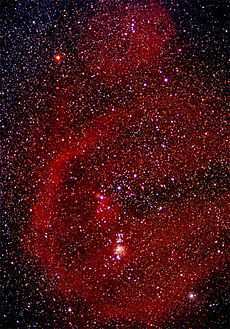
Barnard's Loop (catalogue designation Sh 2-276) is an emission nebula in the constellation of Orion. It is part of a giant molecular cloud which also contains the bright Horsehead and Orion nebulae. The loop takes the form of a large arc centred approximately on the Orion Nebula. The stars within the Orion Nebula are believed to be responsible for ionizing the loop.
The loop extends over about 600 arcminutes as seen from Earth, covering much of Orion. It is well seen in long-exposure photographs, although observers under very dark skies may be able to see it with the naked eye.
It is estimated to lie at a distance of approximately 1600 light years, giving it actual dimensions of about 300 light years across. It is thought to have originated in a supernova explosion about 2 million years ago, which may have also created several known runaway stars, including AE AurigaeMu Columbae and 53 Arietis, which are thought to have been part of a multiple star system in which one component exploded as a supernova.

Pelican Nebula


The Pelican Nebula (also known as IC5070 and IC5067) is an H II region associated with the North America Nebula in the constellation Cygnus. Thenebula resembles a pelican in shape, hence the name. The Pelican Nebula is a large area of emission nebula in the constellation Cygnus (the Swan), close to Deneb, and divided from its brighter, larger neighbor, the North America Nebula, by a molecular cloud filled with dark dust.
The Pelican is much studied because it has a particularly active mix of star formation and evolving gas clouds. The light from young energetic stars is slowly transforming cold gas to hot and causing an ionization front gradually to advance outward. Particularly dense filaments of cold gas are seen to still remain. Millions of years from now this nebula might no longer be known as the Pelican, as the balance and placement of stars and gas will leave something that appears completely different

Hourglass Nebula


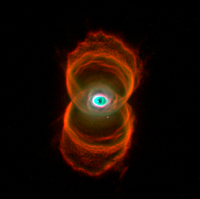
The Engraved Hourglass Nebula (also known as MyCn 18) is a young planetary nebula situated in the southern constellation Musca about 8,000 light-years away from Earth. It was discovered by Annie Jump Cannon and Margaret W. Mayall during their work on an extended Henry Draper Catalogue (the catalogue was built between 1918 and 1924). At the time, it was designated simply as a small faint planetary nebula. Much improved telescopes and imaging techniques allowed the hourglass shape of the nebula to be discovered by Raghvendra Sahai and John Trauger of the Jet Propulsion Laboratory on January 18, 1996. It is conjectured that MyCn 18's hourglass shape is produced by the expansion of a fast stellar wind within a slowly expanding cloudwhich is denser near its equator than its poles.
The Hourglass Nebula was photographed by the Wide Field and Planetary Camera 2 of the Hubble Space Telescope.
A less-famous "Hourglass Nebula" is located inside the Lagoon Nebula.


Hourglass Nebula in popular culture

  • The Hourglass Nebula was featured on the cover of the April 1997 issue of National Geographic. The nebula’s unique appearance led the magazine’s editors to comment, “Astronomers looked 8,000 light-years into the cosmos with the Hubble Space Telescope, and it seemed that the eye of God was staring back.”
  • The Hourglass Nebula also serves as the front cover for Pearl Jam's 2000 album Binaural.
  • The Hourglass Nebula appears in the popular game, Final Doom.
  • The Hourglass Nebula appears on a poster in the CERN laboratory in the film Angels & Demons.
  • The Hourglass Nebula appears in the video game titled Mass Effect 2 as one of the clusters that can be visited for missions.
  • The Hourglass Effect is a 2008 album by the British band Shadowkeep.

Tarantula Nebula


The Tarantula Nebula (also known as 30 Doradus, or NGC 2070) is an H II region in the Large Magellanic Cloud (LMC). It was originally thought to be a star, but in 1751 Nicolas Louis de Lacaille recognized its nebular nature.
The Tarantula Nebula has an apparent magnitude of 8. Considering its distance of about 49 kpc (160,000 light years), this is an extremely luminous non-stellar object. Its luminosity is so great that if it were as close to Earth as the Orion Nebula, the Tarantula Nebula would cast shadows. In fact, it is the most active starburst region known in the Local Group of galaxies. It is also the largest such region in the Local Group with an estimated diameter of 200 pc. The nebula resides on the leading edge of the LMC, where ram pressure stripping, and the compression of the interstellar medium likely resulting from this, is at a maximum. At its core lies the compact star cluster R136 (approx diameter 35 light years) that produces most of the energy that makes the nebula visible. The estimated mass of the cluster is 450,000 solar masses, suggesting it will likely become a globular cluster in the future.
In addition to R136, the Tarantula Nebula also contains an older star cluster—catalogued as Hodge 301—with an age of 20–25 million years. The most massive stars of this cluster have already exploded in supernovae.
The closest supernova observed since the invention of the telescope, Supernova 1987A, occurred in the outskirts of the Tarantula Nebula.

Carina Nebula


The Carina Nebula (also known as the Great Nebula in Carina, the Eta Carina Nebula, or NGC 3372) is a large bright nebula that surrounds several open clusters of stars. Eta Carinae and HD 93129A, two of the most massive and luminous stars in our Milky Way galaxy, are among them. The nebula lies at an estimated distance between 6,500 and 10,000 light years from Earth. It is located in the constellation of Carina. The nebula contains multiple O-type stars.
The nebula is one of the largest diffuse nebulae in our skies. Although it is some four times as large and even brighter than the famous Orion Nebula, the Carina Nebula is much less well known, due to its location far in the Southern Hemisphere. It was discovered by Nicolas Louis de Lacaille in 1751–52 from the Cape of Good Hope.
Within the large bright nebula is a much smaller feature, immediately surrounding Eta Carinae itself. This small nebula is known as the Homunculus Nebula (from the Latin meaning Little Man), and is believed to have been ejected in an enormous outburst in 1841 which briefly made Eta Carinae the second-brightest star in the sky.