Friday, February 25, 2011


Thursday, February 17, 2011
JUPITER'S MOON EUROPA HELPS SOLVE STRIPEY MYSTERY

Last year, something strange happened to Jupiter.
Not only was the gas giant recovering from an asteroid smash, it also underwent a... change. Jupiter lost one of its trademark stripes -- a.k.a. the South Equatorial Belt (SEB) -- for no apparent reason.
Although astronomers at the time theorized that there were perhaps some high-altitude clouds blocking our view of the SEB, it wasn't until the keen infrared eyes of Keck Observatory on Mauna Kea, Hawaii, zoomed in on the planet that the SEB came into focus again.
What's more, Jupiter's moon Europa helped astronomers unravel the mystery as to where the belt has been hiding.
Using the Keck II telescope’s Adaptive Optics system, astronomers would normally point a powerful laser above the observatory to create a "guide star." This artificial point of light can then be used to detect turbulence in the Earth's atmosphere; the shimmering laser signal feeds back into the adaptive optics, allowing the telescope to slightly deform its mirror (in real-time) to compensate for the distortion.
 BIG PIC: Could Observatory Lasers Damage Satellites?
The result is a sharper image of an astronomical target, as atmospheric distortions can be removed from observations. It's these same distortions that can cause stars to "twinkle" at night.
So, with a little help from a little moon, an amazing infrared picture of Jupiter's inner turmoil came into focus.But there was a problem when observing Jupiter. As the planet is so bright, the laser guide star was overwhelmed and couldn't be used for Jovian observations. But all was not lost, Europa was there to lend a hand and on Nov. 30, 2010, it was very bright, right next to Jupiter in the sky. Europa became the "guide star" for the adaptive optics to sense atmospheric distortions.
Thermal infrared radiation (with a wavelength of 5 microns) was detected by Keck leaking from Jupiter's interior. When combining the thermal radiation data with near-infrared solar radiation being reflected by the upper clouds in the Jovian atmosphere, the churning detail in the cloaked SEB was revealed (pictured top).
As the SEB slowly begins to reveal itself once more, icy clouds in the upper atmosphere gradually dissipating, only the Keck infrared telescope could cut through the Jovian atmosphere to reveal the hidden trademark stripe we've been missing out on for these last few months.

About Stars: Wolf-Rayet Stars
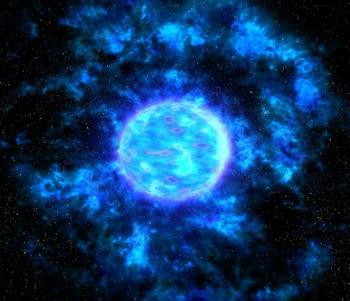 Spectral class: WN, WC
These are very hot and blue stars with surface temperatures of 25 000 - 50 000 kelvin and a mass in the beginning of 25 times solar. Only a few hundred are known in our galaxy. WR stars cast away quickly large parts of their hull into space. Therefore in very big telecsopes they look similar to planetary nebulae.
Before the Wolf-Rayet phase they have been red supergiants or LBV which now expose their core. Supposably every star with enough mass goes through the Wolf-Rayet stadium. These stars are short before an explosion as supernova (astronomically that is. Those stars can as well still live for another several thousand years).
The very strong stellar wind is caused by a heightened accumulation of heavy elements on the surface. These block the light on its way out and therefore heat up the star, which powers the wind. The stellar wind can blow away up to one solar mass every 10 000 years.
Example: WR 124
Red Supergiant Stars
They are the largest stars in the universe in terms of volume, although they are not the most massive.
 Red supergiants (RSGs) are supergiant stars (luminosity class I) of spectral type K or M. They are the largest stars in the universe in terms of volume, although they are not the most massive. Betelgeuse and Antares are the best known examples of a red supergiant.
Stars with more than about 10 solar masses after burning their hydrogen become red supergiants during their helium-burning phase. These stars have very cool surface temperatures (3500–4500 K), and enormous radii. The five largest known red supergiants in the Galaxy are VY Canis Majoris, Mu Cephei, KW Sagitarii, V354 Cephei, and KY Cygni, which all have radii about 1500 times that of the sun (about 7 astronomical units, or 7 times as far as the Earth is from the sun). The radius of most red giants is between 200 and 800 times that of the sun, which is still enough to reach from the sun to Earth and beyond.
These massively large stars are little more than "hot vacuums", having no distinct photosphere and simply "tailing off" into interstellar space. They have a slow, dense, stellar wind and if their core's nuclear reactions slow for any reason (such as transitioning between shell fuels) they may shrink into a blue supergiant. A blue supergiant has a fast but sparse stellar wind and causes the material already expelled from the red supergiant phase to compress into an expanding shell.
The mass of many red supergiants allow them to eventually fuse elements up to iron. Near the end of their lifetimes, they will develop layers of heavier and heavier elements with the heaviest at the core.
The red supergiant phase is relatively short, lasting only a few hundred thousand to a million or so years. The most massive of the red supergiants are thought to evolve to Wolf-Rayet stars, while lower mass red supergiants will likely end their lives as a type II supernova.
The red sun around which the fictitious planet Krypton orbits in both Superman and Superman Returns is also a red supergiant (as opposed to that of a red dwarf star in the comics) that undergoes a supernova explosion, causing Krypton's destruction by means of the shockwaves emitted by the dying star (in the comic series, Krypton was destroyed by the planet's unstable cores).
Red supergiants (RSGs) are supergiant stars (luminosity class I) of spectral type K or M. They are the largest stars in the universe in terms of volume, although they are not the most massive. Betelgeuse and Antares are the best known examples of a red supergiant.Stars with more than about 10 solar masses after burning their hydrogen become red supergiants during their helium-burning phase. These stars have very cool surface temperatures (3500–4500 K), and enormous radii. The five largest known red supergiants in the Galaxy are VY Canis Majoris, Mu Cephei, KW Sagitarii, V354 Cephei, and KY Cygni, which all have radii about 1500 times that of the sun (about 7 astronomical units, or 7 times as far as the Earth is from the sun). The radius of most red giants is between 200 and 800 times that of the sun, which is still enough to reach from the sun to Earth and beyond.
These massively large stars are little more than "hot vacuums", having no distinct photosphere and simply "tailing off" into interstellar space. They have a slow, dense, stellar wind and if their core's nuclear reactions slow for any reason (such as transitioning between shell fuels) they may shrink into a blue supergiant. A blue supergiant has a fast but sparse stellar wind and causes the material already expelled from the red supergiant phase to compress into an expanding shell.
The mass of many red supergiants allow them to eventually fuse elements up to iron. Near the end of their lifetimes, they will develop layers of heavier and heavier elements with the heaviest at the core.
The red supergiant phase is relatively short, lasting only a few hundred thousand to a million or so years. The most massive of the red supergiants are thought to evolve to Wolf-Rayet stars, while lower mass red supergiants will likely end their lives as a type II supernova.
The red sun around which the fictitious planet Krypton orbits in both Superman and Superman Returns is also a red supergiant (as opposed to that of a red dwarf star in the comics) that undergoes a supernova explosion, causing Krypton's destruction by means of the shockwaves emitted by the dying star (in the comic series, Krypton was destroyed by the planet's unstable cores).
About Stars: Red Supergiants
A red supergiant is made of several layers. The outer hull of red glowing hydrogen and helium is inactive. Below this is a layer in which hydrogen is fusioned to helium. In the next layer helium is fusioned to carbon. So it goes on until in the core iron is made. The supergiant shines extremely bright, but only for a short time (still several hundred thousand to million years). In the end the phase in which the star fusions sulfur and silicon to iron only lasts a few days to weeks.
From iron no more energy can be made. The core cools down and implodes. The following supernova (of type II) disrupts the star and leaves a tiny neutron star or a black hole behind.
Red supergiants are frequently very unstable, pulsate and often have a strong stellar wind which blows away their hull.
Example: Betelgeuse
Subscribe to:
Comments (Atom)